Kindergarten and First Grade Reading Benchmarks Parents Should Know
Phonemic awareness and letter sounds in kindergarten predict reading success for years to come.
Reading development follows a sequence, not a checklist. Kindergarten and first grade each have a specific, non-negotiable job to do, and knowing what those jobs are lets a parent tell the difference between normal struggle and an early warning sign.
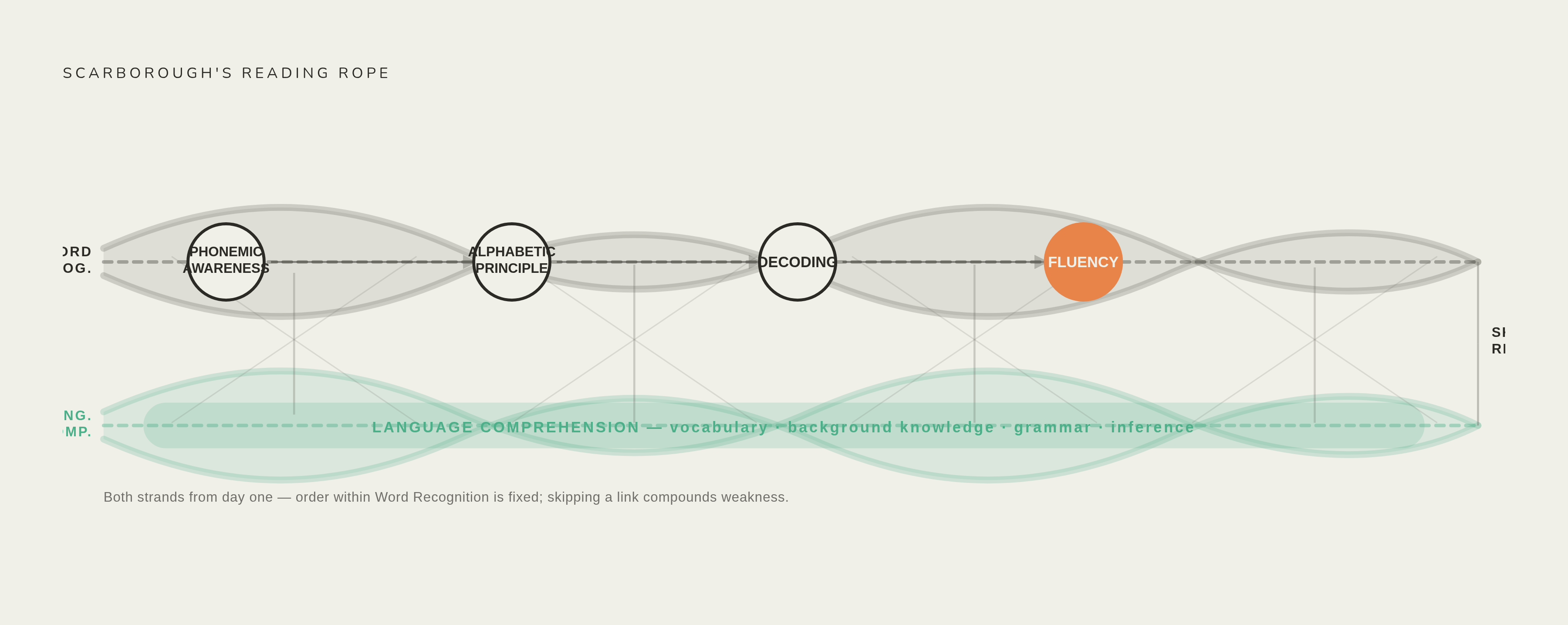
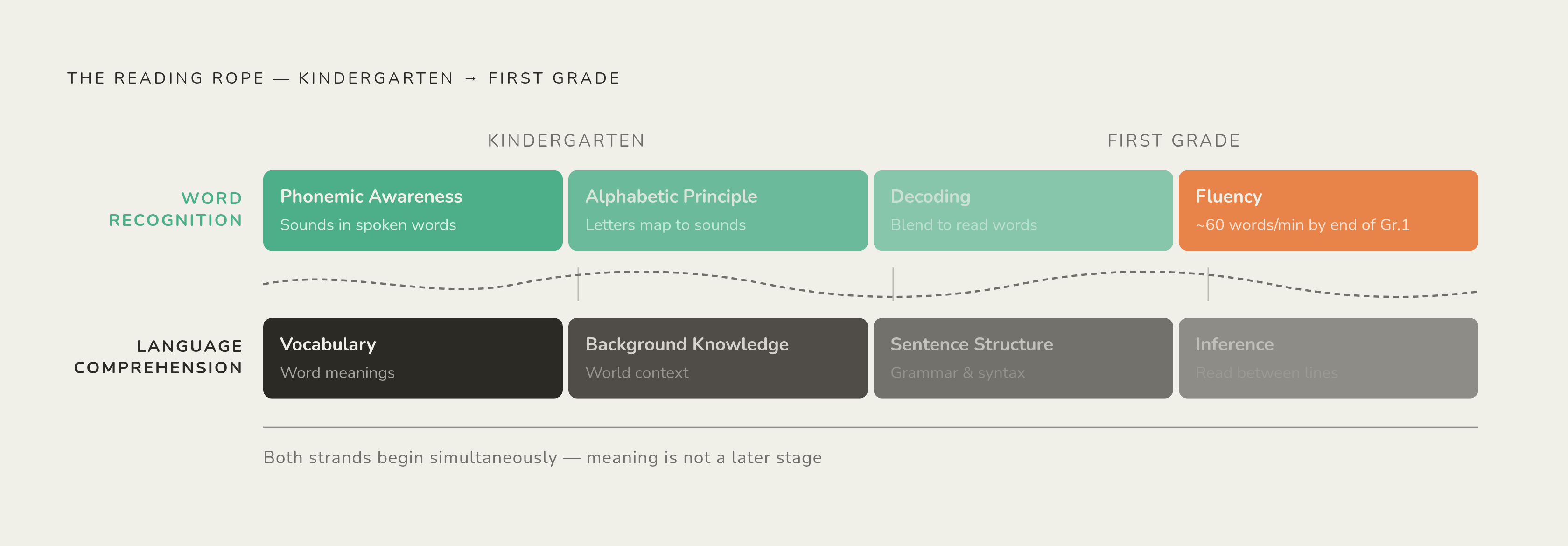
Think of reading as a rope with two strands twisting together: word recognition and language comprehension. That's the model reading researcher Hollis Scarborough proposed, and it explains something parents often get wrong. The strands aren't sequential. A child isn't supposed to master decoding first and then start thinking about meaning later; both cables are being braided from day one, even in kindergarten, even before a child can sound out a single word.
The mechanics of decoding, though, do have their own internal order. Phonemic awareness comes before the alphabetic principle, which comes before decoding, and decoding, once it's fast and effortless, becomes fluency. Skip a link, or rush through it, and the chain compounds its weakness over time. A child who never solidly built phonemic awareness in kindergarten doesn't just have a small kindergarten problem; by third grade, that gap has usually grown teeth.
This is what the Science of Reading actually refers to: a body of research built up over decades across cognitive science, linguistics, and developmental psychology. It draws a sharp line between what kindergarten is for and what first grade is for. Kindergarten cracks the code, while first grade makes the code automatic. Once that distinction is clear, the specific benchmarks below stop being an arbitrary list to memorize and start making sense as stages in one continuous process.
What children should be able to do with sounds by the end of kindergarten
Phonemic awareness is simply the ability to hear and play with the individual sounds inside spoken words, no print involved. Close your eyes: can you tell that "bat" has three sounds, or that swapping the first one gets you "cat"? That's the whole skill, and it happens entirely in the ear.
Kindergartners build this in a fairly predictable order:
- Recognizing and producing rhymes
- Breaking spoken words into syllables
- Isolating the first sound in a short word ("dog" starts with /d/)
- Blending two or three sounds together into a word
- Fully pulling a short word apart into every individual sound: /k/ /æ/ /t/ for "cat"
That last one, full segmentation, is the capstone milestone that tells you the kindergarten year did its job.
The National Reading Panel's research on this is worth sitting with. Phonemic awareness instruction works best when it targets one or two types of sound manipulation at a time, paired with letters rather than taught as a pure listening exercise. Sound-in-isolation practice has a ceiling; sound-plus-letter practice keeps paying off.
Here's a distinction that trips a lot of parents up: a kindergartner who can only tell you "cat" and "hat" rhyme is a step behind where the year is supposed to end. A kindergartner who can pull "cat" apart into three distinct sounds is right on track. Rhyming is an earlier, easier skill, while full segmentation is the finish line.
Phonemic awareness has been identified as the main indicator researchers have found for reading success in kindergarten and first grade. This is worth repeating because it cuts against instinct: a child can recite the alphabet perfectly and still be behind, because phonemic awareness is an auditory skill that has nothing to do with print recognition. Letters come next, and they build on this foundation rather than replacing it.
Letter-sound knowledge and early decoding milestones kindergartners are expected to reach
Once a child can hear sounds inside words, the next job is connecting those sounds to symbols. That's the alphabetic principle: understanding that the letters on the page represent sounds already heard and manipulated in the child's head.
The kindergarten decoding sequence runs roughly like this:
- Naming all 26 letters, upper and lowercase, reliably
- Producing the most common sound for each letter, consonants before short vowels
- Blending simple consonant-vowel-consonant words: "sit," "hop," "ran"
- Reading a small set of high-frequency words that don't decode cleanly, like "the," "I," "said," "is"
That last point deserves a beat of explanation, because it looks like it contradicts everything phonics-first instruction stands for. Why memorize "said" instead of sounding it out? Some words show up so often in early texts that instantly recognizing them frees up mental space for the harder work of decoding new words. Sight words and phonics work as two tools solving two different problems at the same time.
This sequence is codified in local district benchmark documents across the country, which tells you it's standard practice written into public curriculum, not a fringe theory. The Science of Reading position on how phonics gets taught is specific: explicit and systematic, starting with the simplest sound-spelling relationships before moving into anything complex, taught through direct instruction, in order, rather than picked up incidentally from books.
What does it look like when this isn't happening? Picture a kindergartner staring at a simple CVC word, and instead of attempting the sounds, looking at the picture next to it and guessing. That guess-from-context habit feels like reading to a lot of adults watching from the couch, but it functions as a workaround, and it's a sign more explicit letter-sound practice is needed.
The bigger skill jump in first grade: from decoding to reading connected text
First grade asks a child to do something categorically different from kindergarten: take words that used to be sounded out one at a time, in isolation, and read them stitched together into sentences and short passages.
The decoding demands expand fast:
- Consonant blends and digraphs: bl-, str-, ch, sh, th
- Long vowel patterns with silent e: "cake," "pine"
- Vowel teams: "rain," "boat"
- Two-syllable words with simple, regular patterns
At the same time, the sight word list balloons considerably by year's end, and the expectation extends beyond recognition into automaticity: the word should surface instantly, without a pause to think about it.
This is also the year comprehension starts showing its face in a new way. Tracking meaning across a whole sentence, holding onto what happened two sentences ago while reading the third, that's a different cognitive job than decoding a word in isolation ever was.
Why does first grade carry so much weight? The Science of Reading research is fairly blunt about this: code knowledge that doesn't get firmly locked in during these early years gets progressively harder to fix. A gap that looks minor in first grade, a handful of blends that are still shaky, tends to widen once the reading demands of third, fourth, and fifth grade start requiring kids to read to learn, not just learn to read.
One observation parents can actually make without any special training: a first grader who's still reading word... by... word... in a halting, effortful way by the middle of the year, rather than picking up small phrase chunks, hasn't made the automaticity jump yet. That's worth flagging.
What first-grade fluency benchmarks actually look like in numbers
Fluency gets misunderstood as a speed contest, but it's really three things happening together: accuracy, a reasonable pace, and appropriate expression. Drop any one of those, and it's not fluent reading, no matter how fast the words come out.
Fluency matters so much because it's the bridge to comprehension. A child pouring every ounce of working memory into sounding out "elephant" letter by letter has nothing left over to think about what an elephant actually is or why it's in the story. Automatic decoding is what makes room for understanding.
The most widely used reference point in U.S. schools comes from the Hasbrouck and Tindal Oral Reading Fluency Norms. In kindergarten, fluency in connected text isn't really the target yet; accuracy on individual words matters more at that stage. By the end of first grade, though, the average reader hits somewhere around 60 words correct per minute.
That number, 60 WCPM, is a mid-range marker, not a cliff edge. A child well below it by spring of first grade is worth a closer look, while a child well above it is probably ready to move into second-grade-level text.
One nuance parents should hold onto: these norms describe typical development, not a pass-fail line. English language learners, children with dyslexia, and other kids whose learning simply runs on a different track can develop fluency on a different timeline, and that doesn't mean the ceiling is fixed. Most children reach functional reading fluency somewhere between ages 7 and 9. First grade sets the target, and second grade is often where it actually consolidates.
How schools measure whether children are hitting these milestones
Schools don't rely on one instrument. They use several, and each one measures something slightly different.
Lexile levels measure text complexity, functioning as a measure of the book rather than a direct diagnostic of the child's reading skill. Guided Reading levels, the Fountas and Pinnell system, use letter bands from A through Z that match books to a child's demonstrated reading behavior. The DRA, Developmental Reading Assessment, is a teacher-administered tool used to assess early reading development.
Then there's i-Ready Diagnostic, given three times a year, fall, winter, spring, with scores reported as percentiles against a national sample. A fall score at the 90th percentile means the child scored better than the vast majority of peers tested at that same point in the year, nothing more, nothing less.
Some states run their own tracking. Michigan's Early Literacy and Mathematics Benchmark Assessments cover kindergarten through second grade, aligned directly to state standards. Ohio runs a similar K-3 system that feeds into an annual statewide literacy report.
The more useful question for a parent to ask a teacher goes beyond "is my child on level?" to something sharper: which specific skills does this particular assessment cover, and where exactly is the gap? Different tools shine a light on different strands of the Reading Rope. A child can test at grade level on a Lexile-matched comprehension quiz and still have shaky phonemic segmentation underneath, a gap that isn't visible yet but will surface the moment the material gets harder.
What the data from actual classrooms shows about how many children meet these benchmarks
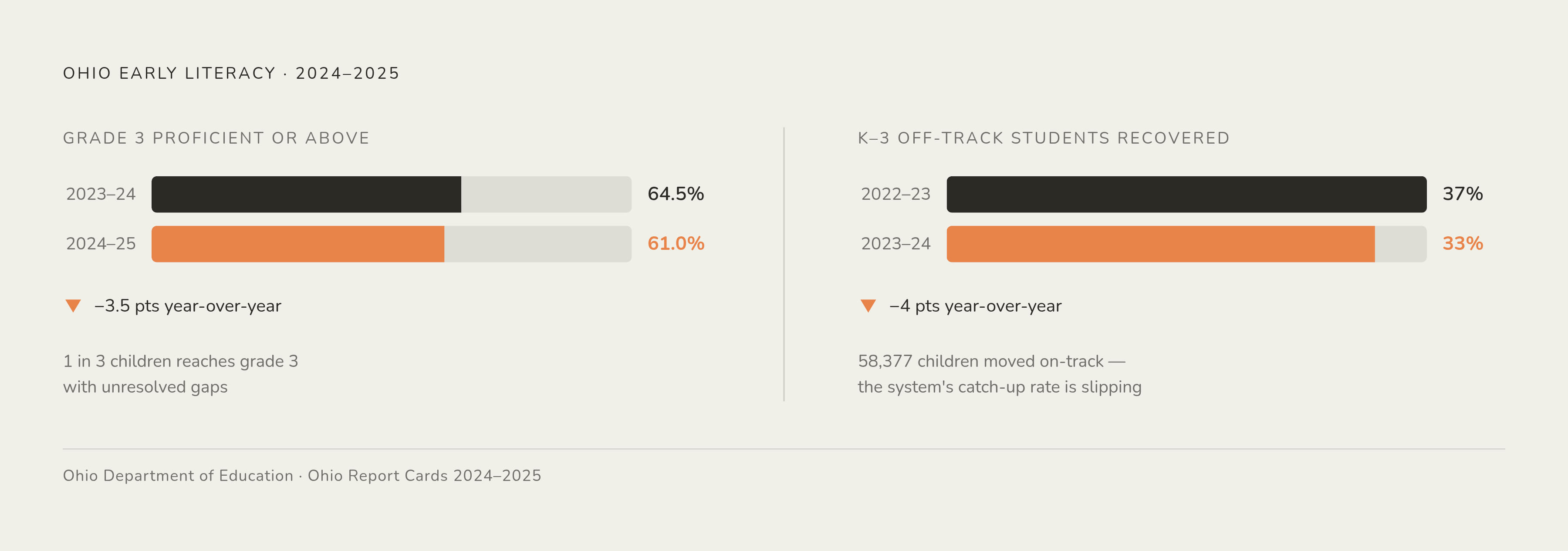
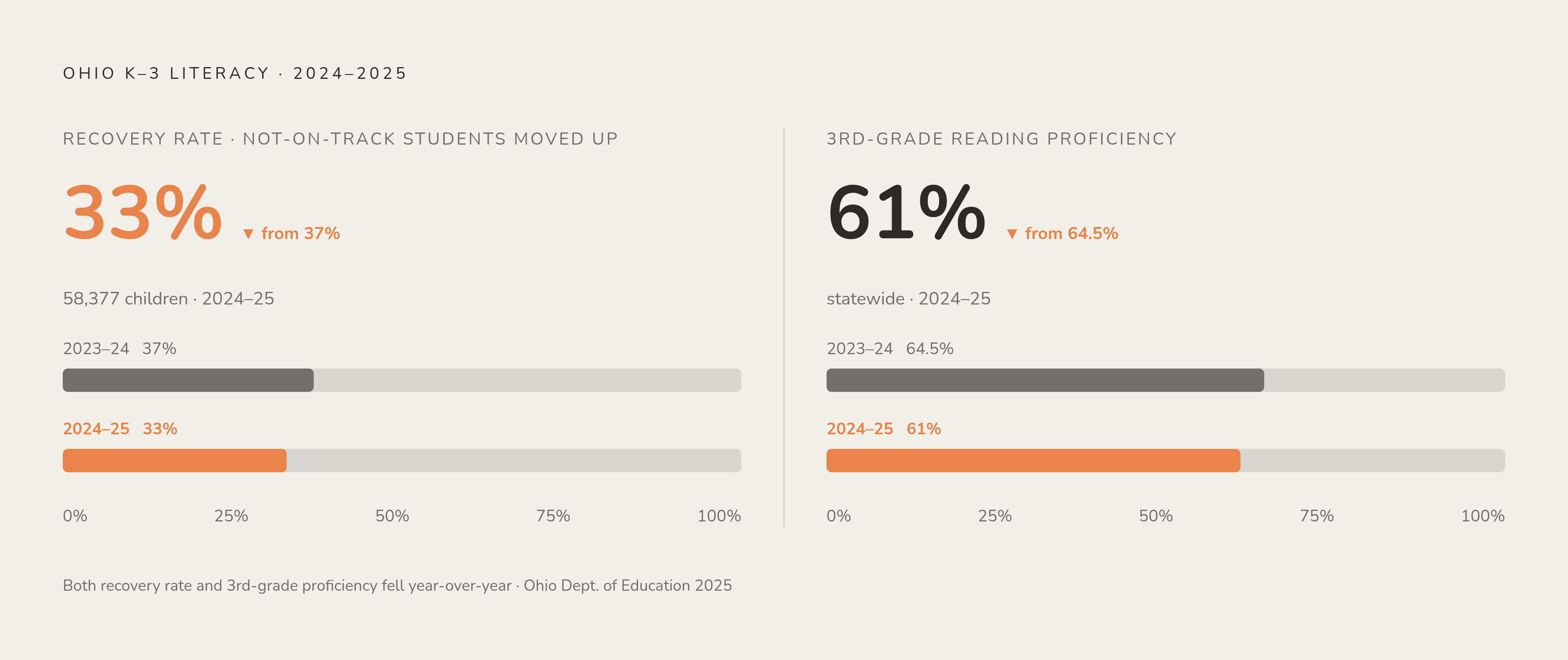
Ohio's 2024-2025 literacy report is a useful window here, mostly because the state publishes grade-by-grade numbers openly. Among third graders, 61% scored proficient or higher on the state ELA assessment in 2024-2025, down from 64.5% the year before. Fourth graders came in at 62% proficient, down from 64.1%. Fifth graders reached 67%.
Sit with that for a second, because even by third grade, roughly one in three or four children hasn't hit the expected reading standard. Most of these children are carrying kindergarten and first-grade gaps that weren't caught, or weren't closed, early enough.
There's a more hopeful thread in the same data, though. Among Ohio's K-3 students who weren't on track in 2023-2024, 33%, 58,377 children, moved into on-track status by fall of 2024-2025. Kids do recover, and targeted support works, but that recovery rate slipped from 37% the year before, which is its own quiet warning: the system's ability to catch kids up is drifting the wrong direction.
None of this is really an Ohio story. Ohio's numbers are worth taking seriously on their own terms; treat these figures as illustrative of how early gaps persist, not as an outlier story. The takeaway is urgency about timing. Recovery is real, but the window where it's easiest closes gradually, year by year, and later is measurably harder than earlier.
Warning signs parents can spot before a report card flags a problem
Report cards lag, and by the time one flags a problem, months have usually already passed. Here's what to watch for before that happens.
During the kindergarten year:
- Can't identify the first sound in a simple word by midyear
- Still confuses or can't reliably name most letters by winter
- Avoids or gets visibly frustrated by anything print-related
- Leans entirely on pictures or context guessing instead of attempting to sound a word out
During first grade:
- Still reading letter-by-letter in spring, no chunking, no whole-word recognition
- Can't read a single short, regular word in isolation, only manages familiar books from memory
- Sight words learned one week vanish the next
- Reading aloud sounds flat, robotic, or painfully slow, with no phrasing at all
One sign by itself rarely means much, but a pattern across several is worth paying attention to. It's worth saying plainly, too: many kids showing these signs have dyslexia, a processing difference, or simply haven't gotten enough explicit instruction yet, and all three are addressable rather than a life sentence. Children develop at different rates for a range of reasons, and variation in timing doesn't automatically signal a lasting deficit.
So what's the first move? Bring the classroom teacher something specific, not a feeling. "She guesses from the picture instead of sounding it out" gives a teacher something to act on more effectively than "she seems behind."
What parents can do at home to support the skills schools are measuring
None of this requires worksheets or a home curriculum. Phonemic awareness practice can happen in a car, at a dinner table, in the fifteen minutes before bed.
Rhyming games work well during a drive. Sound-stretching means saying a word slowly and having the child count the sounds on their fingers. First-sound sorting involves gathering small toys or objects and grouping them by what sound they start with. All of it builds the same auditory muscle the kindergarten benchmarks are measuring.
Reading aloud together is worth doing with more intention than most families realize. Point to words while reading them, and pause before a predictable word to let the child guess what comes next. Ask "what sound does that word start with?" instead of "what word is that?", because the first question builds the skill while the second just tests memorization.
Decodable books matter here too, and they're different from the predictable, pattern-based picture books most households already have on the shelf. A decodable text gives a child real practice applying letter-sound knowledge to a new word, rather than memorizing a repeating sentence pattern and reciting it. Both kinds of books have a place, though most homes are just heavier on one than the other.
A 2022 meta-analysis covering preschool through first grade found that computer programs and parent-led practice add genuine value on top of classroom instruction, functioning as a real supplement alongside a teacher's work. That's an important distinction. AI-powered reading tools that listen to a child read aloud and respond in the moment, prompting, correcting gently, encouraging, can offer more one-on-one repetition than a busy household can realistically carve out on its own.
Not all of these tools are built the same, though, and it's worth asking a few pointed questions before trusting one. Does it catch a child guessing from context, or just let the guess slide by? Does it adjust difficulty based on what the child actually gets right or wrong, not just how quickly they're tapping the screen? Does it give a parent any real visibility into which specific skills are landing and which aren't?
The best tools work alongside a shared book, a conversation, and the relationship a child has with an adult who's paying attention, buying back practice time and handing parents better information, so that the time spent together, reading side by side, actually counts for more.