Phonemic Awareness Before Phonics in Early Readers
Children must isolate individual sounds before learning which letters represent them.
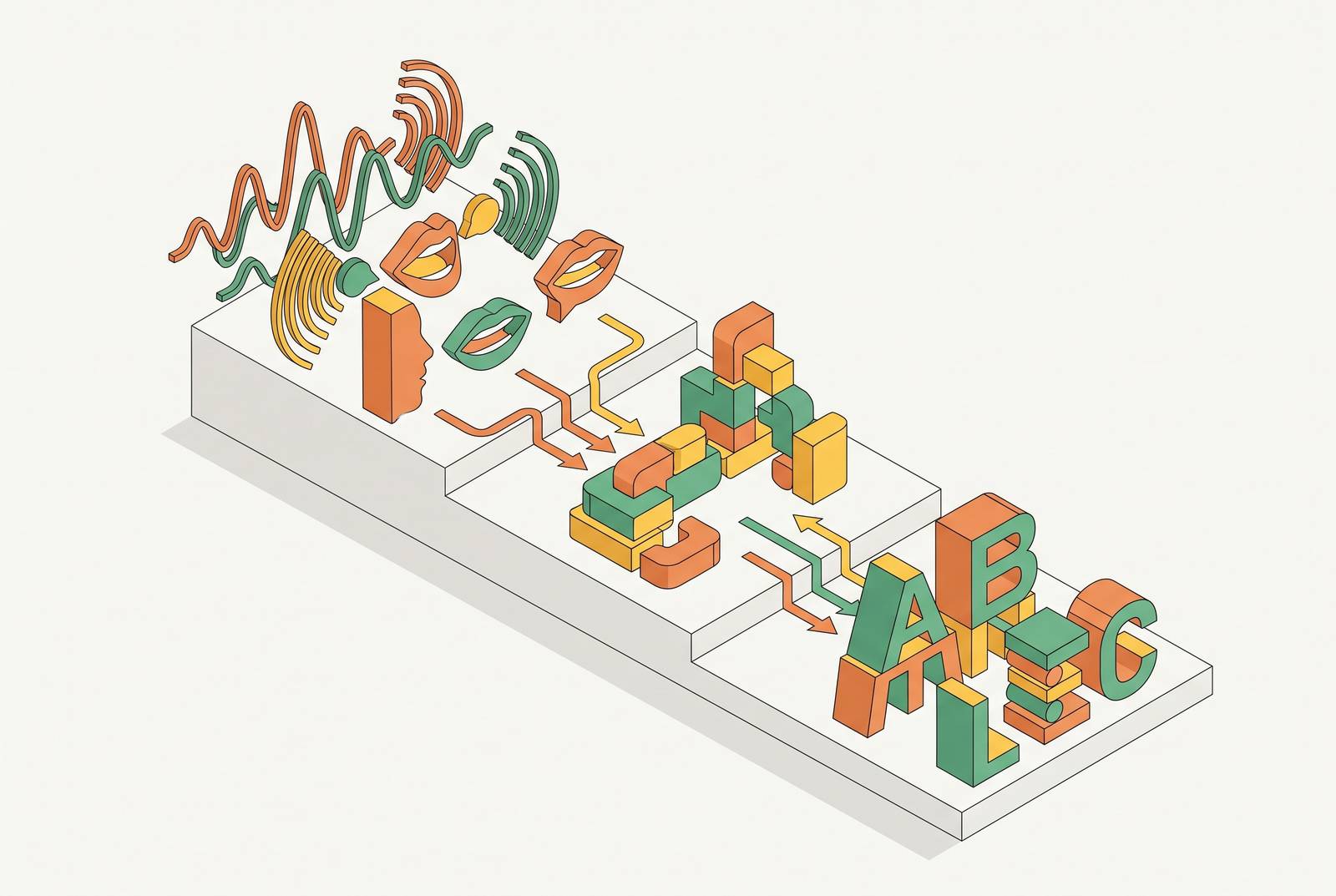
Phonemic awareness has to come before phonics, full stop. A child who can't hear the individual sounds inside a spoken word has nothing for phonics instruction to attach itself to. Phonics teaches letters standing in for sounds; if the sound isn't yet a distinct, isolatable thing in a child's mind, the letter has no job to do. Most confusion about early reading traces back to one mistake: treating phonics, phonemic awareness, and phonological awareness as interchangeable words for the same skill, and that mistake is the single biggest reason so many kids get the wrong kind of help at the wrong time.
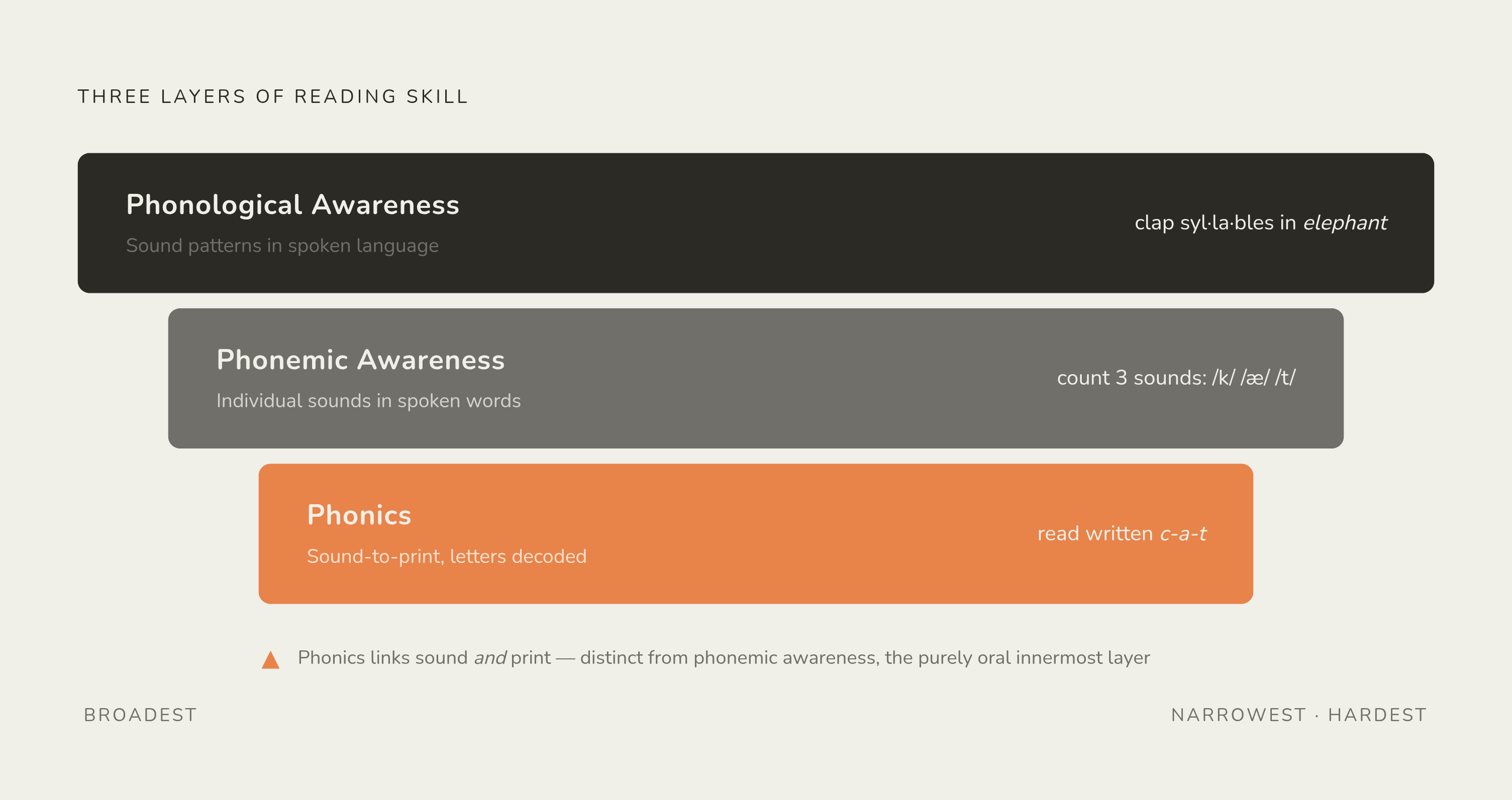
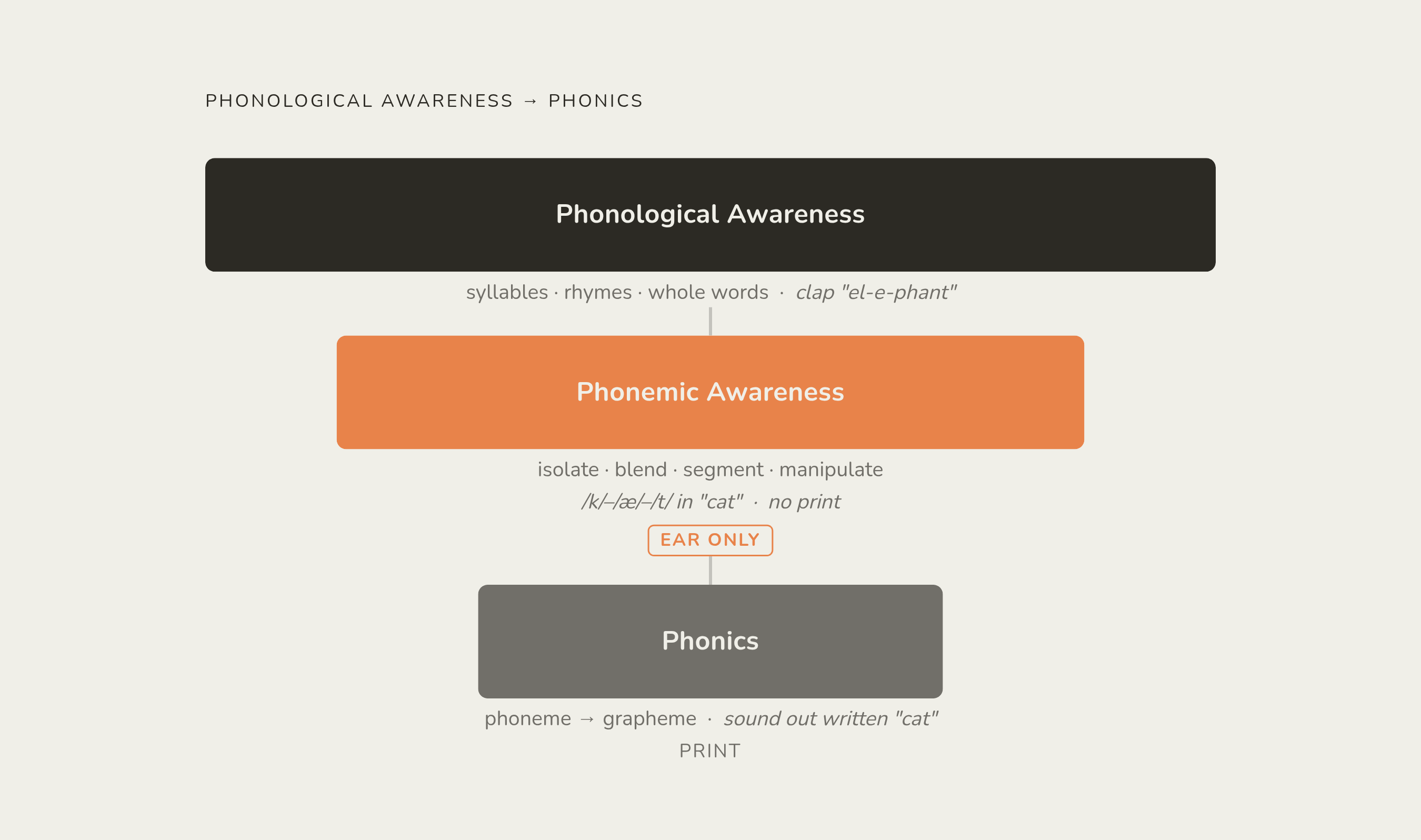
They aren't interchangeable, and collapsing them costs real instructional time. Phonological awareness is the broad category: hearing and playing with chunks of sound at any level, whole words, syllables, rhymes. Phonemic awareness sits at the bottom of that category, the narrowest and hardest layer, where a child isolates, blends, segments, and manipulates individual phonemes. Phonics connects those sounds to print, to actual letters and letter combinations on a page.
Clapping out the syllables in "elephant" is phonological awareness. Counting the three separate sounds in "cat," /k/-/æ/-/t/, is phonemic awareness, while sounding out the written word "cat" using letter-sound rules is phonics. Three different skills, three different levels of difficulty, and parents (along with more than a few teachers) routinely flatten all three into the single word "phonics." That collapse hides the one fact that matters most here: phonemic awareness happens entirely in the ear, with no print and no letters involved, just sound.
Spoken language never hands phonemes to a listener as neat, separate units. They overlap and blur in the stream of speech; the /k/ in "cat" bleeds straight into the vowel after it, and no acoustic gap announces where one sound stops and the next begins. Hearing these as separate units takes deliberate attention, and it doesn't happen automatically from listening to people talk, no matter how much talking a child is exposed to.
A child who can't break "ship" into /ʃ/-/ɪ/-/p/ has no mental slot to hook a letter onto. Teach the letter combination sh to a child who has never isolated /ʃ/ as its own sound, and nothing gets connected; a shape gets memorized instead.
Reading development runs through three stages. First, the logographic phase: kids recognize whole words by their visual shape, guessing from context and memorized outlines, with zero mapping between letters and sounds. Second, the alphabetic phase, where phonological decoding switches on and a child can look at unfamiliar letters and generate the sounds. Third, the orthographic phase, where word recognition finally becomes automatic and effortless.
The move from logographic to alphabetic is gated, specifically and only, by phonemic awareness, and no shortcut exists around it. The payoff isn't limited to sounding out new words, though; it feeds orthographic mapping, the process that bonds a spelling to its pronunciation and builds a child's bank of instantly recognized sight words. Orthographic mapping runs on phonemic awareness as its raw material. Skip that material, and the bank doesn't get built; it gets faked, one memorized shape at a time, and that fakery is exactly what falls apart later, usually around third grade when texts stop repeating familiar words.
Reading researchers Louisa Moats and colleagues rank phonological and phonemic awareness among the strongest known predictors of later reading skill, and the deficits show up again and again in kids who struggle. That finding isn't a minor correlation buried in a footnote. It's one of the most consistent results in the field, and it's the reason so much early literacy work now centers on sound before symbol.
How phonemic awareness develops in children ages 4–9
The skills build in a fairly fixed order: rhyme recognition, then syllable blending and segmenting, then onset-rime awareness (splitting "cat" into "c" and "at"), then phoneme blending, then phoneme segmenting, and finally phoneme manipulation (deleting or swapping individual sounds). Each stage demands finer discrimination than the one before it, and skipping ahead doesn't work; a child who can't blend can't segment, and a child who can't segment can't manipulate.
Blending and segmenting matter most of everything on that list, because they transfer most directly to actual reading. A child who blends /d/-/o/-/g/ into "dog" is doing, in miniature, exactly what decoding a printed word requires later. Rhyming is a warm-up act; blending and segmenting are the main event.
Most four-year-olds already rhyme words and clap out syllables without much trouble; that part comes easily. Full phoneme segmentation, breaking a word all the way down into its individual sounds, usually solidifies during kindergarten and the early part of first grade. The gap between kids who arrive at kindergarten with strong phonemic awareness and those who don't is visible before a single phonics lesson gets taught, and left alone, it widens instead of closing.
Isolating individual phonemes is not a skill most kids just absorb by listening. Because phonemes aren't naturally separated in speech, this step usually needs direct, explicit instruction, and some kids need a lot more of it than others. English language learners and children with speech or language differences often need extra time and more structured repetition at each stage. Rushing past that need doesn't speed anything up; it creates gaps that surface later, usually right when phonics instruction starts and there's nothing solid underneath it.
Why oral-only phonemic awareness practice has a ceiling (and what happens after it)
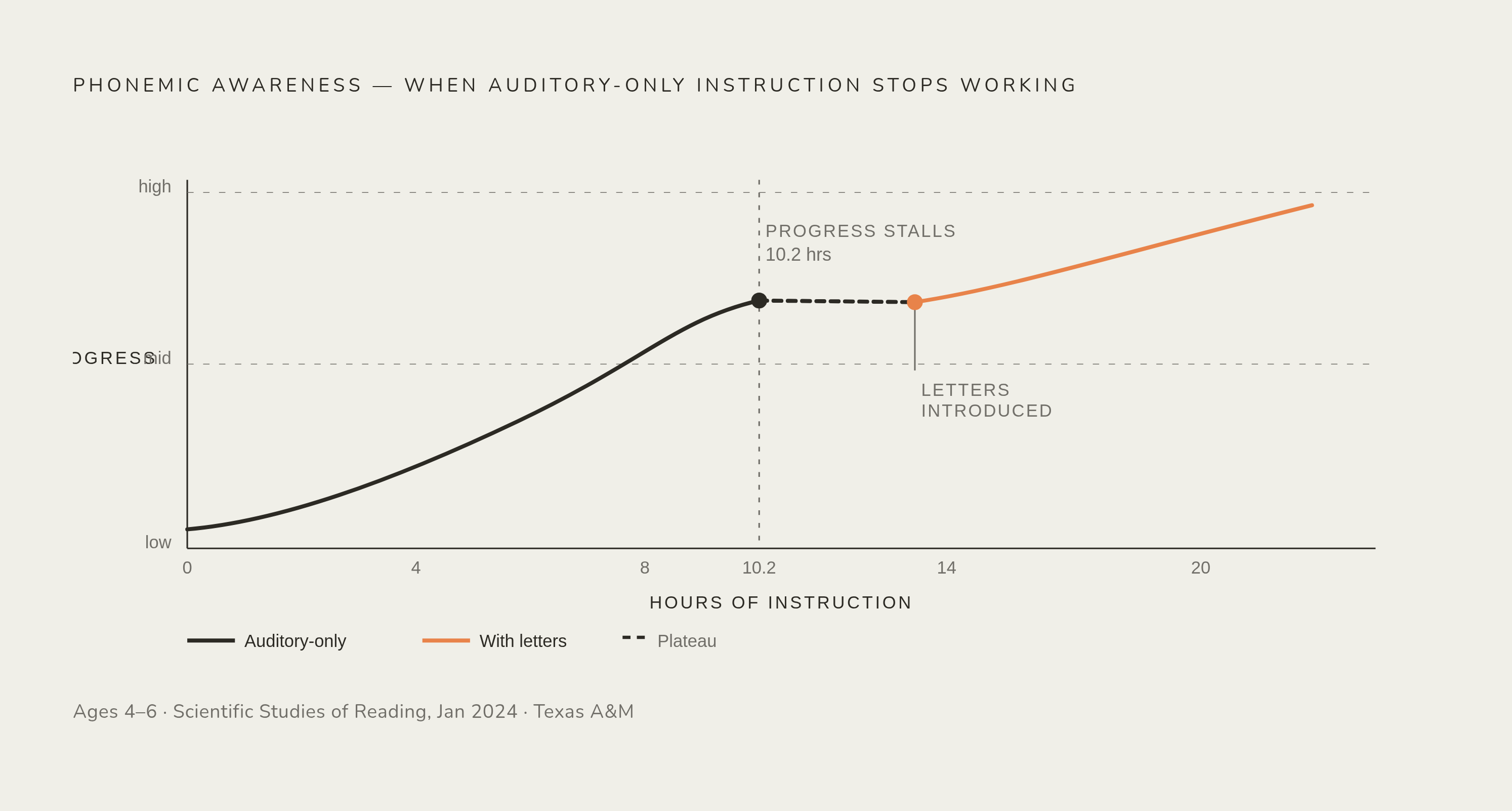
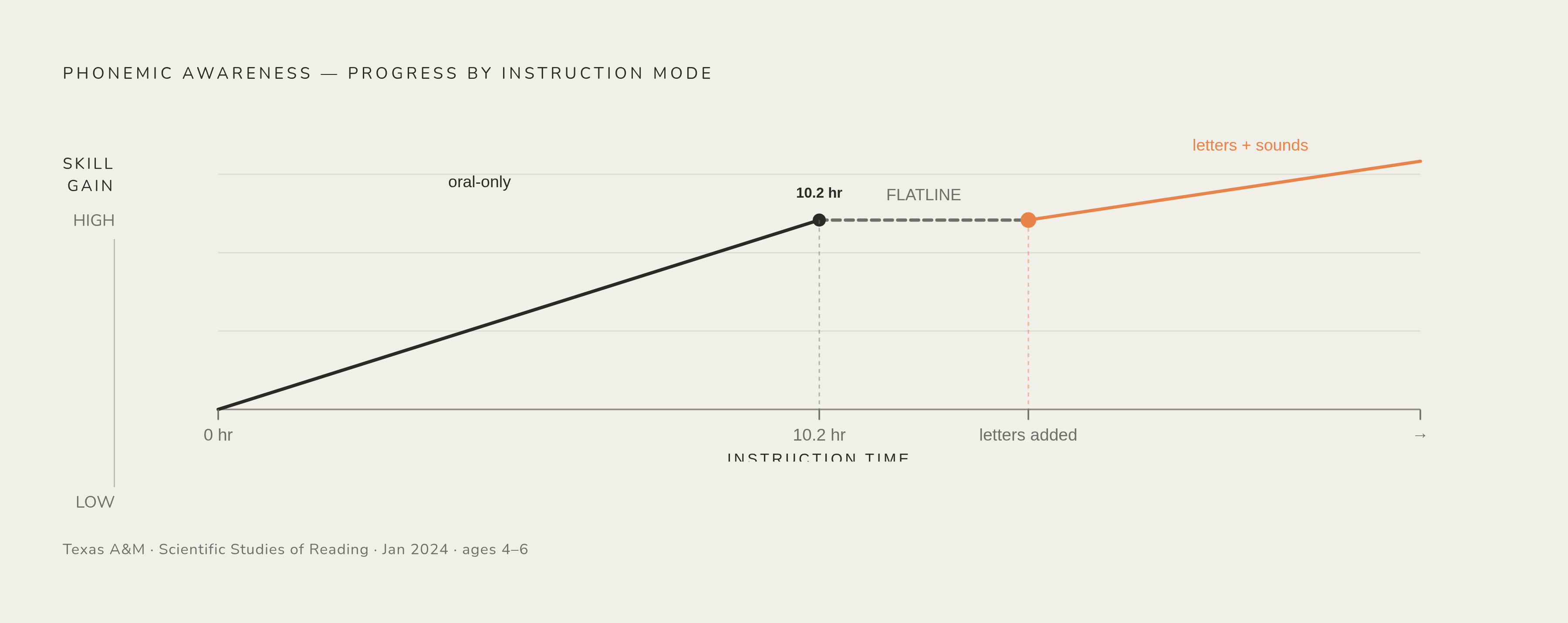
Here's a finding worth sitting with, because it complicates the tidy sequence above. Researchers at Texas A&M, publishing in Scientific Studies of Reading in January 2024, found that struggling readers between ages four and six stopped making progress after roughly 10.2 hours of purely auditory phonemic awareness instruction delivered in small-group or tutoring settings. Past that point, the oral-only approach flattened out completely, and kids only resumed progressing once visual letter displays got paired with the sounds.
That 10.2-hour number should worry anyone still running phonemic awareness programs that keep letters out of the room for weeks on end, because it cuts against the popular assumption that phonemic awareness has to be fully mastered, in the abstract, before letters ever enter the picture. Phonemic awareness needs to come first developmentally, in that the sound-concept has to exist before a letter can attach to it, but that's a claim about sequence, not about how long oral-only instruction should run. Sound and print need to meet fairly quickly, not months apart.
Researchers Nell Duke, Alida Lindsey, and Sara Wise, writing in the Handbook on the Science of Early Literacy, call this "instructional simultaneity." Once a child knows even a handful of letters, phonemic awareness work is best done with those letters physically present, not stripped away in the name of keeping the skill "pure."
Plenty of schools still run scripted, oral-only phonemic awareness programs, and the appeal is obvious: they're simple to deliver, engaging for young kids, and don't require juggling letter tiles or printed materials. Weighed against the 10.2-hour ceiling, though, that's the wrong tradeoff, and it's worth saying plainly rather than hedging around it. These programs keep sound and print artificially separated well past the point where separation helps. The useful question for a parent is whether the specific program a child uses connects sounds to letters at the moment the child is ready, not months later.
What effective phonemic awareness instruction looks like in practice
Louisa Moats and colleagues, in a 2024 guide written for educators, recommend short daily doses over long infrequent blocks, particularly for kindergarten and first-grade students, English language learners, and older kids still struggling. Precision skills like this one build through repetition spaced across days, not through marathon sessions once a week.
The priority activities: blending phonemes into words, segmenting words into their component phonemes, and manipulating phonemes by swapping or deleting sounds. Rhyming games have a place early, but they're not where the real transfer to reading happens, and instruction that lingers too long at the rhyme-and-syllable level is stalling on the easy part while the harder, more valuable work sits untouched.
Letter tiles, sound boxes (often called Elkonin boxes, where a child pushes a token into a box for each sound in a word), and visual letter displays speed things up considerably once basic phoneme awareness is in place. Given the Texas A&M ceiling, the case for introducing these tools earlier than a strict "sounds only" sequence recommends is a strong one, not a marginal one.
Anyone evaluating a program or app for this stage should ask a short set of questions: Does it work at the phoneme level specifically, not just syllables or rhymes? Does it bring in letters exactly when the child is ready, rather than holding them back arbitrarily or dumping them in too soon? Does it adapt when a child struggles or plateaus, instead of marching forward on a fixed schedule no matter what?
How phonics instruction builds on phonemic awareness (and what breaks down when the foundation is thin)
Phonics teaches the relationship between phonemes and graphemes, the letters and letter combinations that represent them. That's a translation task by definition, and it only works if the child already holds the sound concept in mind and just needs a symbol attached to it.
When phonemic awareness is weak, phonics instruction produces something that looks like reading but isn't. Kids memorize the visual shape of letter patterns instead of decoding them; they're still stuck in the logographic phase, just wearing the costume of the alphabetic one. It can look convincing for a while, especially on familiar words the child has seen dozens of times, and that's exactly what makes it dangerous. A parent watching a six-year-old breeze through a favorite picture book has no way of knowing whether they're seeing decoding or memorization.
The trouble surfaces later, and it surfaces predictably. Reading that looked fine on simple, repeated vocabulary stalls out the moment texts introduce new, unfamiliar words the child hasn't memorized by sight, and decoding, the exact thing phonics was supposed to build, breaks down right when it's needed most.
Fluency, meaning reading that's accurate, automatic, and expressive, depends on phonics becoming second nature, and that automaticity depends on phoneme-grapheme bonds being solidly encoded from the start. A shaky phonemic foundation doesn't just slow the early stages. It slows the entire chain that follows, all the way through to comprehension.
Decodable books exist to bridge this gap, letting a child apply newly learned letter-sound patterns inside real running text, which is where automaticity actually gets built. That only works if the phonics knowledge being applied rests on genuine phoneme awareness underneath. Otherwise the child is guessing with slightly better props.
Two problems get lumped together that shouldn't be, and mixing them up wastes time a struggling reader doesn't have to spare. A child who decodes fine but doesn't understand what they've read usually has a vocabulary or language comprehension issue sitting on top of otherwise solid mechanics, while a child who can't decode reliably almost always has a phonemic awareness or phonics gap underneath. Different problems need different fixes.
The National Reading Panel's 2000 report, and the broader body of research now grouped under the Science of Reading, backs explicit, systematic phonics instruction as producing meaningfully better outcomes than looser, incidental approaches, particularly for beginning readers, at-risk readers, and kids already struggling. That's not a close call in the research, and programs still built around incidental, discovery-based phonics are fighting the evidence, not just a trend.
What parents can watch for (and how adaptive instruction helps when a child is stuck)
A few warning signs show up early, and they're consistent enough to watch for directly. A child guesses at words from the first letter and a picture on the page, rather than sounding the word out, or rhymes just fine but freezes when asked to blend individual sounds together. A child, asked how many sounds are in "fish," genuinely can't answer, and struggles badly with any word not already memorized by sight.
There's a subtler sign too, one that shows up after phonics instruction has already started: letter-sound rules taught and seemingly learned in isolation just don't transfer to actual reading. The same word types keep producing the same errors, lesson after lesson. That pattern usually means the phonics is sitting on top of a phonemic awareness gap, not a solid foundation, and no amount of re-teaching the letter rule will fix it until the gap underneath gets addressed.
At home, oral sound games do more good than another round of reading aloud. Asking "how many sounds do you hear in the word 'fish'?" costs nothing, takes thirty seconds, and hits the exact skill that matters most at this stage.
The scale of the problem deserves plain language. A large share of children in the U.S. read below basic proficiency. Sit with that number for a moment and it stops looking like a small gap in an otherwise functioning system. It looks like evidence that one-size-fits-all instruction has been failing a substantial number of kids for a while, which means the fix has to involve more than the same instruction delivered louder.
Adaptive instruction offers real-time adjustment, slowing down at a sticking point and speeding up once a child is ready, the way a skilled human tutor works. A 2024 meta-analysis published in Educational Research Review, led by Alrawashdeh and colleagues, found personalized and adaptive learning technology outperforming traditional one-size-fits-all instruction specifically on reading literacy outcomes, and that gap is the whole argument for choosing adaptive tools over fixed-script programs when a child is stuck.
For any parent sizing up an app or program, a short checklist helps: Does it assess phonemic awareness on its own terms, separate from phonics? Does it actually listen to a child read aloud and respond to what it hears, rather than just tracking taps and clicks? Does it report back in a way a parent can use, something that points to what to work on next?